

Ikenotaira Onsen
The wide-runway Myoko sleeper with a hot-spring finish
 池平温泉
池平温泉Ikenotaira Onsen
8.5~13m
Snowfall
1530m
Elevation
5
Lifts
¥6,900
Price
Wide turns, warm soaks, zero drama
Ikenotaira Onsen sits on the Myoko Kogen flank like the relaxed mate in a rowdy friend group. It’s close to the action, but it doesn’t yell for attention. The vibe is cruisy, the slopes are famously wide, and the whole place feels built for smooth days: fast access, simple layout, and enough variety to keep upper intermediates grinning without forcing you into survival skiing.
This is a resort that rewards good decision-making. If you’re the type who likes stacking clean carves on corduroy when the sun pops, it delivers. If it’s storming and you want shelter, there are in-bounds tree edges and protected lanes that let you keep moving when other hills turn into a flat-light sufferfest. And if you’ve got a mixed crew, this is one of the easiest Myoko Kogen options to keep everyone happy without constant regrouping.
Affordability is generally mid for the Myoko Kogen area, with the real value play being convenience: you can base nearby, ski a full day without mega lines, and finish with an onsen soak without needing a long commute or a big itinerary. Food on-mountain is practical, and the surrounding onsen zone has enough to keep you fed and warm between runs.
English is present but not front-and-centre. You’ll get by with basic travel Japanese and ski-resort body language, and a lot of staff are used to visitors in winter. Weekdays are mellow. Weekends can get busier, especially if families and local groups are out, but the width of the pistes spreads people out so it rarely feels like a cattle run.
Resort Stats
Estimated cumulative fresh snowfall at major on-mountain ski areas; actual totals vary substantially by resort, elevation, measurement location, and season.
- Vertical771m (1530m → 759m)
- Snowfall~13m
- Terrain 40% 45% 15%
- Tree Riding
- Lift Pass¥6,900
- Lifts1 quad, 4 pair
- Crowds
- Out of Boundspatrol may take pass
- Night Skiing
- Family Friendly
- Trails16
- Skiable Area~60ha
- Vibewide cruisers, onsen base, sneaky trees
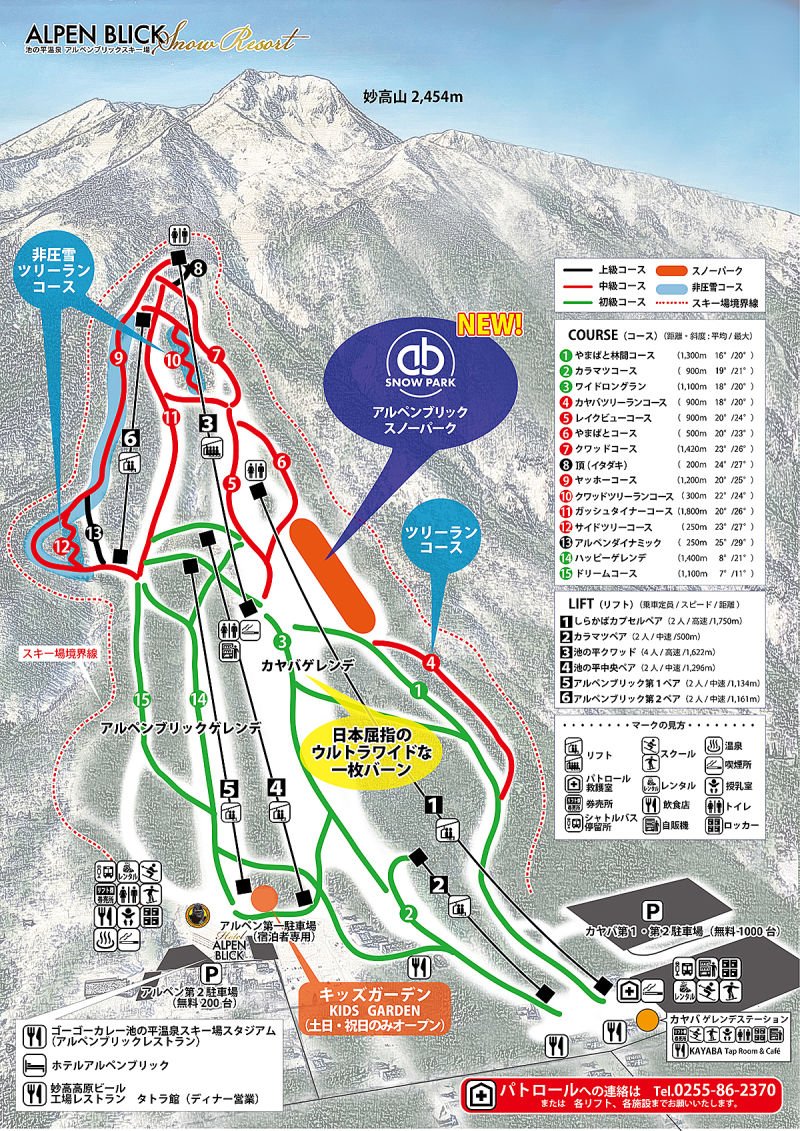
Trail Map
Accommodation
View MapIf you want the easiest ski rhythm, Hotel Alpen Blick (Alpen Blick Resort) is the obvious play. You’re right on the doorstep, the whole place is built around winter convenience, and the onsen angle is baked in. It’s the kind of base where you can do first lift without a commute, take a midday reset if the legs are cooked, then roll back out for a few final runs.
For a more modern stay with a calm, design-forward vibe, Lime Resort Myoko Kogen is a strong pick in the broader area. It’s less ski-lodge chaos and more relaxed retreat: good for couples, small groups, or anyone who wants their evenings quiet and comfortable rather than loud and late. Bonus points if you care about a proper soak and a tidy, refined feel after a full day on snow.
If you want more dining and nightlife energy, base in Akakura Onsen and day-trip Ikenotaira Onsen. Options like Hotel Taiko give you that classic onsen-town experience with more bars, izakaya, and evening choices, while keeping you close enough for quick morning transfers. This combo works well if you’re skiing multiple Myoko Kogen resorts and want one hub with the most after-dark options.
Powder & Terrain
Ikenotaira Onsen is split into two personalities: the big open face that makes you feel like you’ve rented your own ski hill, and the quieter edges where the good snow lingers longer than you’d expect. The headline is width. When Myoko Kogen gets one of those steady, cold storms and visibility is average at best, those wide pistes become a safety net because you can dial speed and line choice without feeling boxed in by crowds or tight choke points.
The core day for most riders is built around the Ikenotaira Onsen Quad and the long feeder lifts like the Shirakaba Capsule Pair. This is where the resort’s flow shows. You can work top-to-bottom cruisers, then peel off into the side hits, tree lines, and little rollovers that sit just off the main lanes. The snow quality is classic Myoko Kogen: dry enough to feel quick underfoot, often stacking in predictable drifts along treelines and in sheltered pockets.
Don’t come here expecting sustained steepness. The advanced terrain exists, but it’s not the point. The best riding is about timing and positioning. Early on a storm morning, the side-of-run snow is the move: short punches into the trees, then back onto the piste to keep it safe and fast. By late morning, the main runs will show traffic, but the width keeps it from turning into a mogul minefield too quickly.
Storm-day plan is simple: stay on the protected aspects, keep your speed managed, and farm the edges. When wind or low cloud rolls in, the mellow gradients help, because you can keep moving without that sketchy, blind commitment you get on steeper faces. If the snow is heavier or the storm is warm, the resort still holds up well because grooming coverage is strong and you can pick cleaner lines.
Sidecountry and touring are a real thing in the Myoko Kogen region, but treat anything beyond marked boundaries with respect. This is not a resort with a famous gate network designed to funnel you safely out and back. If you don’t know the zone, don’t freestyle it. The smart play is to enjoy what’s in-bounds, then book a proper guide day elsewhere in Myoko Kogen when you want to stretch into bigger terrain.
Getting There
Closest major airport is Tokyo (Narita or Haneda), with Nagano as the common rail gateway. The typical flow is: train toward Nagano, then continue to the Myoko Kogen area via local connections to Myoko Kogen-Kogen Station, then a short bus or taxi to Ikenotaira Onsen. If you’re already doing a Myoko Kogen trip, it’s one of the easiest resorts to slot in.
By car, it’s straightforward winter driving as long as you respect the storm cycles. Snowfall can be serious here. Run proper winter tyres, carry chains, and don’t assume you’ll be fine because the road looked clear an hour ago. On big snow days, give yourself buffer time, drive smooth, and be ready for short delays near resort access roads.
The main gotcha is timing: storms in Myoko Kogen can ramp overnight, and morning road conditions can lag behind the snowfall. If it’s dumping, leave earlier than you think, and keep your plan simple so you’re not stressed before you’ve even clicked in.
Who's it for?
- First-timersGood
- Powder huntersGood
- Non-skiersOkay
- BudgetOkay
- LogisticsOkay
You’ll love Ikenotaira Onsen if you want a smooth Myoko Kogen day with minimal friction: wide slopes, easy navigation, and a resort that lets you ski by feel rather than by strategy. It’s especially good for upper intermediates who want to ski fast and clean, families who want space, and mixed groups where not everyone is hunting steep trees all day.
You might feel limited if your whole trip is about steep technical lines, tight fall-line trees, and aggressive terrain variety. There are better options in the Myoko Kogen orbit for that. Use Ikenotaira Onsen as the confidence day, the visibility day, the park day, or the one where you want to finish early and soak properly.
Food & Après
On-mountain, keep expectations realistic: this is comfort fuel, not a culinary mission. The handy move is to eat close to the lifts so you don’t waste good snow time. Café & Restaurant KAYABA is a reliable anchor near the action, and it’s the sort of place you can duck into when the weather turns and you want a warm reset without killing half an hour.
Off the slopes, the Ikenotaira Onsen onsen area has a few solid casual options, and the wider Myoko Kogen zone opens up quickly if you’re staying in Akakura. If you want a simple, good night out, aim for an izakaya-style dinner in town, then keep apres mellow: a drink, a soak, and an early night so you’re not dragging yourself to first chair.
The signature move here is the hot-spring finish. Ski hard, drop the gear, and go straight to an onsen session. It’s the most Myoko Kogen thing you can do, and it turns a good ski day into a great one.
Japow Travel Tips
- Lift hours: typically 8:30–16:00 (season and conditions can shift the exact close)
- Avalanche / backcountry reality: in-bounds is the play unless you know the zone well; outside the ropes can have consequences, and this area is not a casual wander zone
- Weather & snow patterns: classic Myoko Kogen storms, frequent snowfall, and occasional low visibility; the wide pistes make storm skiing feel safer and more fun
- Language/cultural quirks: plenty of visitors in the region, but don’t expect everything in English; keep it polite, simple, and you’ll be fine
- Anything unique: the sheer width of the main slopes and the onsen-first resort culture, plus a strong terrain park scene for those who want it
- Nearby resorts worth pairing: If you’re doing a Myoko Kogen sampler week, pair Ikenotaira Onsen with Akakura Onsen for steeper, more classic resort energy, Akakura Kanko for a more premium mountain feel and longer fall-line runs, Myoko Kogen Suginohara when you want fast vertical and a different rhythm, and Lotte Arai for a bigger, more modern resort day when you’re chasing variety and infrastructure.
Verdict: The easy-win Myoko Kogen day
Ikenotaira Onsen is a stoke-preserving resort: wide slopes that stay fun even when the weather turns, enough in-bounds variety to keep things interesting, and a low-drama flow that suits real-world trips. It’s not the steepest hill in the region, but it’s one of the easiest places to have a genuinely great day, then finish with an onsen soak and feel like you’re doing Japan properly.