
Ryuoo
Ropeway-powered Japow above onsen towns
 竜王
竜王Ropeway to the good stuff
Ryuoo sits in northern Nagano, above the Yudanaka and Shibu Onsen orbit, where your ski day can end in a proper soak instead of a fluorescent hotel bathtub. The mountain has a split personality: lower, cruisy pistes that keep intermediates happy, and a higher ropeway-served zone that turns into a snow globe on the right storm cycle. It’s not the biggest “destination village” scene, but it’s got real terrain and a surprisingly punchy vertical for this corner of Nagano.
The vibe is mostly Japanese domestic, with a steady trickle of international riders who’ve figured out the onsen towns are a cheat code. You’ll see families on the lower runs, snowboarders hunting trees up high, and plenty of locals who know exactly which side of the ropeway drops in better when visibility is cooked. It’s friendly, low-key, and generally more about skiing than showing off.
Affordability sits in the middle. You can do it cheap if you base in Yudanaka and eat like a normal person (ramen, soba, conbini), or you can go full ryokan mode in Shibu and make the post-ski kaiseki dinner the main event. English is limited on-mountain, but the basics are easy, and the onsen towns have enough tourism infrastructure that you won’t feel stranded.
Weekdays can be delightfully chill, especially outside peak holiday windows. Weekends are a different story: ropeway queues can spike, beginner zones get busy, and powder lines get found early. Family friendliness is solid on the lower mountain, but advanced riders should treat Ryuoo as a storm-day playground that rewards route choice, timing, and a bit of patience.
Resort Stats
Estimated cumulative fresh snowfall at major on-mountain ski areas; actual totals vary substantially by resort, elevation, measurement location, and season.
- Vertical1080m (1930m → 850m)
- Snowfall~10m
- Terrain 25% 35% 40%
- Tree Riding
- Lift Pass¥5,200
- Lifts1 ropeway, 2 quads, 5 doubles, 1 triple
- Crowds
- Out of Boundspatrol may take pass
- Night Skiing
- Family Friendly
- Trails17
- Skiable Area~98ha
- Vibeonsen base-camp, storm-day hunting
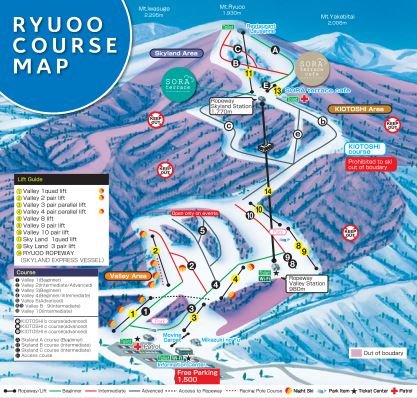
Trail Map
Accommodation
View MapIf you want ski-in/ski-out convenience, the main move is staying right at the base in a resort-style hotel. Ryuo Park Hotel is the obvious anchor, and it’s the kind of place where the biggest luxury is waking up close to the lifts, not designer furniture. It’s practical for early starts, especially on storm mornings when the access road is slow and you just want to clip in and go.
For the best overall experience, base yourself in the onsen towns. Shibu Onsen is the classic vibe: narrow lanes, wooden ryokan, and that post-ski wander where you bounce between baths and snack stops like it’s a second sport. For memorable stays, look at iconic ryokan like Kanaguya (historic, atmospheric) or more polished comfort at places like Kokuya. You trade a short commute for a much richer evenings scene, minus the nightclub nonsense.
If you want something simpler and more flexible, Yudanaka Onsen is a solid hub with easier rail access and a bit more “normal town” energy. Properties like Aburaya Tosen give you a comfortable onsen base with enough services nearby to keep things easy. For ultra-practical budgets, Nagano City business hotels can work (think Hotel Metropolitan Nagano or similar), but you’ll want an early alarm and a car, and it feels more like commuting than doing a ski trip.
Powder & Terrain
Ryuoo’s best days are the ones where the valley looks grey and miserable but the upper mountain is quietly filling in. The higher ropeway-served zone skis colder and lighter than the base, and when it’s snowing hard you can ride by feel in the trees instead of squinting down an empty white horizon. The snow quality is at its best when temps stay low and the wind isn’t hammering the ridgelines. If it warms up, the lower mountain turns into a more typical Honshu mix of soft groomers and heavier off-piste.
Pitch-wise, there’s more bite here than people expect. The lower runs are friendly and flowy, but the upper mountain has steeper fall-line options, plus plenty of terrain where you can let the skis run for a few turns before ducking into trees to reset your legs. The terrain isn’t endless, but the vertical is real, so it doesn’t feel like you’re stuck doing short, repetitive sections all day.
How the day skis changes fast. First hour after a storm, anything obvious off the ropeway gets tracked quickly, especially if it’s a weekend. The move is to avoid the most direct exits, pick zones that require a little more traverse or a slightly less convenient re-entry, and keep an eye on where people are bunching up. Ryuoo is a classic mountain where the best snow isn’t always the steepest line, it’s the line with the fewest bootpacks and the most awkward return.
Lift dynamics matter here. The ropeway is the engine room, but it doesn’t run like a high-speed gondola you can spam every six minutes. When it’s busy, you get pulses of people arriving at the top, which can strip a zone quickly and then leave it quiet again. If you time it right, you can score a couple of quality descents while the crowd is still shuffling at the top, then drop lower while everyone else repeats the same obvious pitch.
Sidecountry and touring exist, but treat it with respect. This is real mountain terrain, and the avalanche picture can change quickly in storm cycles or wind events. If you’re thinking beyond the obvious in-bounds tree zones, you want proper kit, proper partners, and a conservative brain. For most riders, the sweet spot is skiing the best in-bounds off-piste trees and natural features, then heading back to the onsen towns before your legs turn to jelly.
Getting There
Closest major airport access is via Tokyo (Haneda or Narita), then train to Nagano. From Tokyo, the shinkansen to Nagano Station is about ~90 minutes, then you can connect to the Nagano Dentetsu line toward Yudanaka Station (about ~45 minutes). From there, it’s typically a short bus or taxi hop up to the resort area, depending on where you’re staying.
Driving is often the smoothest option if you’re doing a northern Nagano road trip. Expect ~45–60 minutes from Nagano City in normal winter conditions, and longer in storms. Snow tires are not optional, and you’ll want chains in the car if a big system rolls through. The main gotcha is timing: leave earlier than you think on storm mornings, because access roads can slow down right when everyone decides it’s a ski day.
If you’re staying in Shibu or Yudanaka, you can keep it easy: short morning commute, ski, then you’re back in the baths before the day-trippers even clear the parking lot.
Who's it for?
- First-timersOkay
- Powder huntersGood
- Non-skiersOkay
- BudgetOkay
- LogisticsOkay
Ryuoo is for powder hunters who like a practical base, a strong vertical, and terrain that rewards a bit of local-style problem solving. If you’re happy chasing stashes, managing ropeway timing, and finishing the day with an onsen soak, it’s a very satisfying hill.
You might feel limited if you want a huge, interconnected mega-resort with endless lift options and a party village at the base. Beginners can have a good time on the lower mountain, but if your crew needs wide-open greens all day, you’ll still want to pick your timing to avoid the weekend chaos. And if you’re only here for perfectly spaced, low-angle tree cruising, there are other Nagano hills that do mellow trees more consistently.
Food & Après
On-mountain, expect straightforward Japanese ski-hill fuel: curry rice, ramen, katsudon, and the kind of hot drinks that taste better just because your gloves are steaming. Restaurant Lausanne is a known go-to on the hill, and it’s exactly what you want between storm runs: quick, warm, and not trying to be fancy.
For better eats, the onsen towns win. In Yudanaka and Shibu, the best nights are simple: pick an izakaya, order skewers, local veg, and something sizzling, then roll straight to the baths. Nagano soba is the regional staple, and it hits perfectly after a cold day. If you want a mellow après, it’s more about a casual beer, a convenience-store feast, or a quiet bar than any kind of loud ski-party scene.
The real apres here is the onsen rhythm. Ski hard, rinse the snow out of your hair, soak until your legs stop shaking, then eat something salty and go to bed early. It’s not glamorous, but it’s the kind of routine that lets you stack good ski days back-to-back.
Japow Travel Tips
- Lift hours: Day skiing is typically around 8:00–17:00; night skiing is offered on select nights/areas in-season, usually into the evening.
- Avalanche / backcountry reality: The upper mountain and surrounding terrain are real alpine ground. Stay conservative unless you’ve got the experience, kit, and partners to match.
- Weather & snow patterns: Best conditions come with Sea of Japan storm cycles that keep temps cold up high. Wind can affect exposed ridges and visibility can be brutal without trees.
- Language/cultural quirks: Mostly domestic vibe; be polite in lift lines, keep noise down in ryokan, and follow onsen etiquette (wash first, tattoos can be sensitive depending on the place).
- Anything unique: The ropeway access and high viewpoint culture pulls in non-ski visitors too, which can influence base-area crowding at peak times.
- Nearby resorts worth pairing: Shiga Kogen (bigger, higher, more variety), Nozawa Onsen (iconic town + long runs), Madarao (tree-focused storm riding), Tangram (family-friendly and calmer), Yomase (local-feeling alternative day).
Verdict: Ropeway powder with an onsen cheat code
Ryuoo is the kind of place that doesn’t need to be the biggest to be worth your time: it has proper vertical, a high top that stays cold, and enough tree terrain to keep you skiing when visibility is a mess. Add the Yudanaka and Shibu Onsen base-camp options and it becomes a super efficient powder mission: hunt snow all day, soak all night, repeat until your legs tap out.