

Japan Ski Trip From the USA
Flights, Airports, Bags & Best Routes
If you are flying to Japan from the USA for a ski trip, the hardest part is not the flight. It is the decisions you make before you book: which airport you fly into, whether you base yourself on Honshu or Hokkaido, and how you move your ski bag once you land.
Get those right and the trip feels surprisingly smooth. You land, you point yourself at the snow, and suddenly you are eating ramen in ski socks wondering why you did not do this years ago.
The big decision: Tokyo or Sapporo?
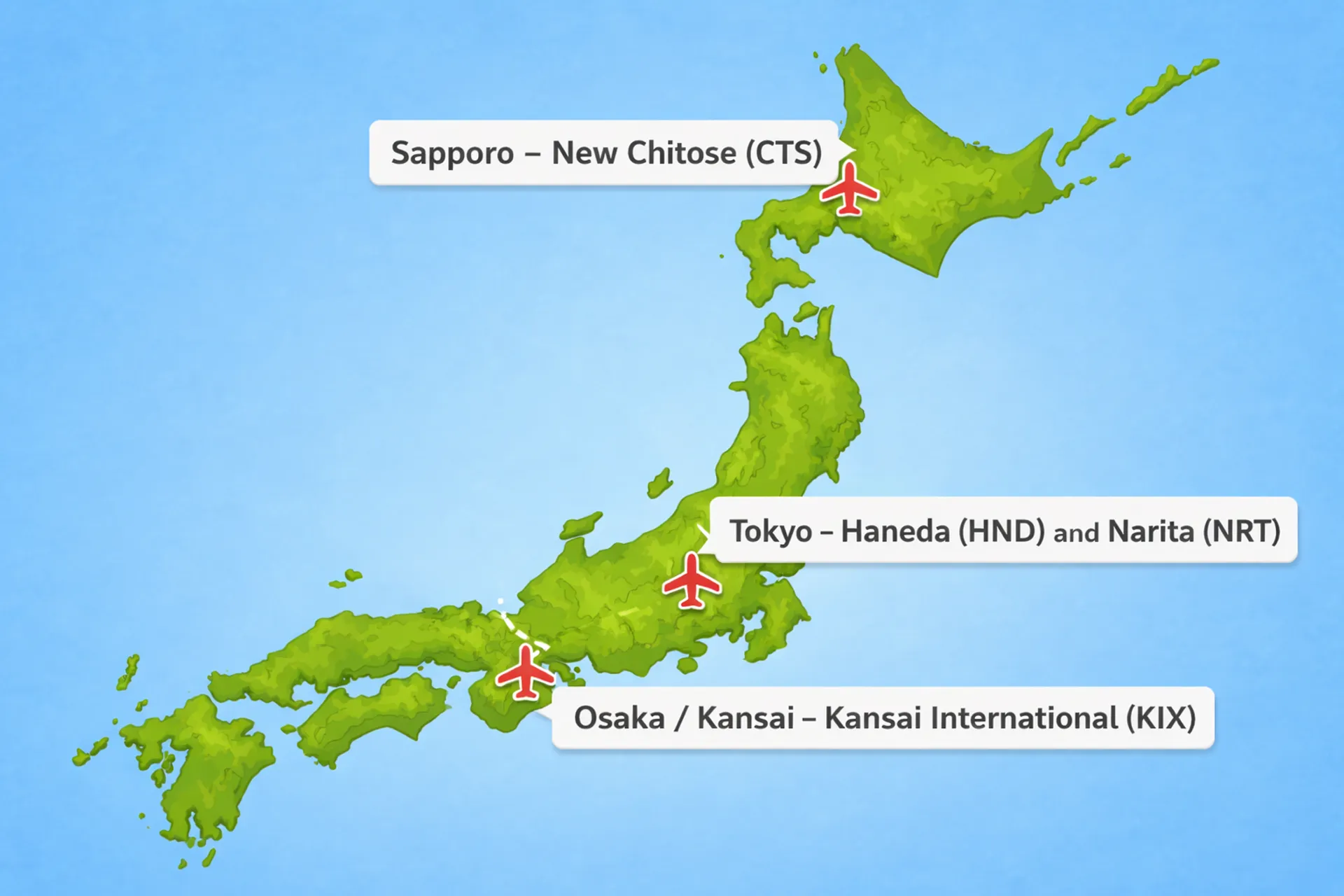
From the USA, almost every ski trip plan routes through one of these gateways:
Tokyo Haneda (HND) and Narita (NRT)
Sapporo New Chitose (CTS)
There is no “best” airport in a vacuum. There is only the airport that matches your ski region.
If your main targets are Honshu (Nagano, Niigata, Tohoku), Tokyo is the simplest and most flexible entry. If your main targets are Hokkaido (Niseko, Rusutsu, Kiroro, Furano), Sapporo’s New Chitose is usually the cleanest.
You can absolutely do both islands in one trip, but you will almost always use Tokyo as the bridge because domestic flights between Tokyo and Sapporo are frequent and straightforward.
Tokyo airports: Haneda vs Narita for skiers
Tokyo has two international airports and both work.
Haneda (HND) is closer to central Tokyo. For many travellers it feels easier on arrival because you are not immediately committing to a longer airport transfer while jet lag is doing its thing.
Narita (NRT) is further out, but it has a huge volume of international flights and tends to have plenty of options from US airlines and partners.
From a ski trip perspective, the key point is this: both airports can get you into Tokyo, and from Tokyo you can reach a lot of ski country quickly by bullet train.
Sapporo’s New Chitose: the Hokkaido ski hub
If you are committing to Hokkaido, New Chitose (CTS) is the money airport.
In winter, there are direct ski buses to major areas like Niseko and Rusutsu, and you can also route to Furano and other regions via Sapporo or rail connections. If your goal is to land and be in snow country without the Tokyo detour, CTS makes that possible.
If you like the idea of mixing city nights with skiing, Sapporo is also a very easy add on. It is a real Japanese city with great food and a proper winter vibe, and it pairs well with a Hokkaido ski itinerary.
Best flight routing from the USA by region
Japan flight planning is mostly about keeping the number of “pain points” low. Pain points are tight connections, awkward ski bag transfers, and arriving late at night then trying to improvise a three step transit chain in a new country.
Here is how it usually plays out for US travellers.
West Coast
West Coast travellers have the simplest access. Direct flights to Tokyo are common from major West Coast airports, and even one stop options are usually clean.
If you are skiing Honshu, a direct flight to Tokyo plus one bullet train is an easy win.
If you are skiing Hokkaido, you have two solid patterns:
- Fly to Tokyo, then connect to a domestic flight to New Chitose
- Fly to New Chitose via a partner hub if the schedule and price are good
The best choice is usually the one with the fewest tight connection risks. A slightly longer itinerary that gives you breathing room can be smarter than the “fastest on paper” option that falls apart the moment a flight is delayed.
Mountain West and Southwest
From places like Denver, Salt Lake City, Phoenix, Las Vegas and similar, you are often connecting through a West Coast hub or a major US hub that has strong Japan service.
The practical planning tip here is to treat the long haul segment as the anchor. Build the rest of the itinerary around getting onto that long haul flight without stress, especially if you are traveling with a ski bag and a boot bag.
If you are arriving into Tokyo and heading straight to the mountains, a one night buffer in Tokyo can make the whole trip feel calmer. You sleep, reset, then move on with a clear head.
Midwest and East Coast
From the Midwest and East Coast, the main question is whether you can get a direct to Tokyo from your home airport. If you can, it is often worth it, even if it is not the cheapest fare. Fewer connections usually means fewer chances for your ski bag to go sightseeing without you.
If you cannot, the typical pattern is a domestic hop to a major hub, then the long haul to Tokyo, then onward to the mountains.
If you are planning both Honshu and Hokkaido in one trip, consider a multi city ticket so you are not forced to backtrack. Flying into Tokyo and out of Sapporo (or the reverse) can save time and reduce total travel friction.
Where should you go first: Honshu or Hokkaido?
If you have not skied Japan before, Honshu is often the easiest “first timer” experience because it is so well connected by train from Tokyo. You can do a city night or two, hop a Shinkansen, and suddenly you are in ski towns without needing another flight.
If you want the most streamlined “land close to snow” plan, Hokkaido is hard to beat. Fly into New Chitose, get on a ski bus, and you can be in Niseko or Rusutsu without ever touching Tokyo.
If you want the best of both, do it as a two part trip. Start in Honshu while your legs are fresh and you want variety, then hop to Hokkaido for a second act that is pure winter.
The easiest airport to resort routes
This is the section most people actually need. You can spend hours debating airlines, but the trip lives or dies on how easily you get from the airport to your base.
Tokyo to Yuzawa and Niigata (fast and underrated)
If you want maximum skiing with minimum travel time after landing, Niigata is the quiet assassin.
From Tokyo you can take the Joetsu Shinkansen to Echigo Yuzawa in roughly an hour and change, often around 75 to 90 minutes depending on service. From there, multiple resorts are within easy reach.
For US travellers on a tighter trip length, this is one of the smartest plays in Japan. You get proper snow, onsen vibes, and a very efficient transit chain.
Tokyo to Hakuba (classic, popular, slightly more moving parts)
Hakuba is iconic and it is still one of the most common targets for US visitors.
A typical public transport chain is Tokyo to Nagano by Shinkansen, then a bus to Hakuba. It is not hard, but it is two legs, and weather can slow road transfers. If you want it to feel smooth, aim to arrive into Nagano with daylight and some buffer, especially if you are traveling with big bags.
There are also seasonal direct shuttles and private transfer options. They cost more, but they reduce decision fatigue and work well for groups.
Tokyo to Nozawa Onsen (great village, straightforward access)
Nozawa Onsen is very doable from Tokyo by train plus a short local connection, commonly via the Hokuriku Shinkansen corridor. It is a great “proper Japan” ski town experience and works well for US visitors who want atmosphere as much as powder.
New Chitose to Niseko and Rusutsu (winter ski buses make it easy)
For Hokkaido, New Chitose to Niseko or Rusutsu is one of the cleanest airport to resort transfers in Japan, especially in winter when ski buses run. Book ahead in peak weeks, because popular departure times can fill.
If you are staying in Grand Hirafu, you can usually plan around the main bus drop offs, then walk or taxi to your accommodation.
New Chitose to Furano (possible, but plan the timing)
Furano is very achievable from New Chitose, but it usually takes more timing awareness than Niseko. Depending on your approach, you may route via Sapporo or rail connections, or you may use seasonal buses. It is not difficult, but it is worth aligning your arrival time so you are not arriving late and then trying to connect through multiple legs in winter.
If you want Furano with the least friction, consider a night in Sapporo on arrival, then travel onward the next morning.
Ski bags from the USA: what to expect and how to pack smart
This is where US travellers often overthink things. The trick is to make your travel days simple and repeatable.
Airline baggage and ski equipment
Policies vary by airline and fare type, but the general pattern is that skis or snowboards can be checked as sports equipment, often within standard checked baggage allowances as long as you meet weight limits.
Because rules change and fare classes differ, the safest approach is to confirm baggage allowance for the exact ticket you are buying. Do that before you book and you avoid the “surprise fee” moment at check in.
A packing setup that works in Japan
Japan is not just airports. It is train stations, stairs, platforms, and sometimes a short walk through snow to your accommodation. A setup that feels fine in the US can become annoying when you are dragging it through Tokyo Station at rush hour.
A simple, realistic setup for most skiers and riders is:
One ski or board bag, one rolling suitcase or duffel, and one backpack.
That is the sweet spot. You can still move through stations and hotel lobbies without feeling like you are relocating a small apartment.
If you are traveling with friends, spreading essentials across bags is smart. If one bag is delayed, it is much easier to keep the trip alive if everyone still has base layers and goggles.
The cheat code: luggage forwarding inside Japan
If there is one travel move that makes US to Japan ski trips feel effortless, it is luggage forwarding.
Japan has reliable door to door luggage delivery services (often called takkyubin). You can send suitcases and sometimes ski bags between hotels, or from an airport counter to your next accommodation. It is incredibly useful when you want a couple of city days without dragging ski gear through Tokyo, or when you are changing bases mid trip.
A common US traveller pattern is:
Land in Tokyo, forward the ski bag to the resort, spend one or two nights in the city with just a small suitcase, then meet your gear in the mountains.
It turns your arrival into a normal travel day instead of a gear hauling mission.
Best routes for US travellers (sample itineraries)
Instead of listing ten options, here are a few that consistently work well.
One week, first Japan trip, Honshu focus
Fly into Tokyo. Spend one night to reset. Take a Shinkansen to your ski region the next day. Ski five to seven days depending on the trip length. Return to Tokyo for one final night if you want city time, then fly home.
This is simple, flexible, and it absorbs delays better than a plan that depends on a tight same day connection from an international arrival to a mountain transfer.
One week, Hokkaido snow mission
Fly into New Chitose. Take a winter ski bus to Niseko or Rusutsu. Ski hard. Add one Sapporo night at the end if you like food and nightlife. Fly home.
This is the best “minimal moving parts” powder trip for US travellers who do not care about Tokyo this time.
Ten to fourteen days, both islands
Fly into Tokyo, ski Honshu for a week, then fly domestic to Sapporo and ski Hokkaido for a second week. Fly home from Sapporo if the ticketing works, or return via Tokyo if needed.
If you do this, build in one buffer night around the island transfer. It makes the trip feel much smoother and protects your ski days.
FAQ for US travellers
Is it better to fly into Tokyo or Sapporo?
Tokyo is best for Honshu ski regions and for trips that mix city and snow. Sapporo’s New Chitose is best for Hokkaido focused trips where you want to land close to the mountains.
How long should a Japan ski trip be from the USA?
From the West Coast, seven to nine days can work well. From the Midwest and East Coast, ten to fourteen days usually feels better because the travel is longer and jet lag can hit harder.
Do I need to speak Japanese to navigate airports and trains?
No. Major airports and train stations are used to international travellers, and signage is commonly bilingual. A little preparation helps, but you do not need Japanese fluency to pull off a smooth ski trip.
Should I bring my own skis or snowboard?
If you love your setup and especially if you have dialed boots, bringing your own gear is often worth it. Renting in Japan is also very doable in major resort areas. The deciding factor is usually boots and personal preference, not availability.
What is the easiest ski region to reach from Tokyo?
Niigata’s Yuzawa area is one of the fastest and easiest because it is on a direct Shinkansen corridor from Tokyo and the resort access chain is short.
The simplest way to plan your US to Japan ski trip
If you are stuck, use this decision flow:
Pick your island first (Honshu or Hokkaido). Choose the airport that matches it (Tokyo or New Chitose). Then build a route that minimizes the number of same day connections after you land.
Do that and the trip stops feeling like an international logistics puzzle. It becomes what it should be: one long flight, one clean transfer chain, and then a week or two of deep snow, onsens, and that “how is this real?” feeling you only get in Japan.