

Okutadami Maruyama
The spring-ski secret that refuses to quit
 奥只見
奥只見Okutadami Maruyama
8.4~15m
Snowfall
1242m
Elevation
5
Lifts
¥4,500
Price
Dam-road turns and late-season gold
Okutadami Maruyama is one of those resorts that makes you double-check the calendar. While most of Japan is in full mid-winter rhythm, Okutadami’s access road can be the limiting factor, and the resort’s real party trick is how good it can be once the spring switch flips. Think big snow totals, long daylight, and a vibe that’s more bring-a-thermos than book-a-nightclub.
The mountain itself feels like a wide-open playground built for fast, confident skiing rather than technical survival turns. The pistes are broad, the sightlines are good, and you can stitch together surprisingly long top-to-bottom runs for a resort that sits out in the sticks. It’s not a steep-and-deep proving ground, but it’s way more interesting than a groomer-only hill.
Who’s it for? Strong intermediates and up who like covering ground, carving real arcs, and ducking into in-bounds trees when the snow’s soft. It’s also a magnet for park riders later in the season, because Okutadami is known for building features when other places are melting out. Beginners can still have a good day here, but it’s better once you’re comfortable at speed.
On crowds and comfort: weekdays are usually light, weekends can jump up when the conditions are good and the park is firing. English presence is limited and the scene is mostly domestic, but it’s easy to navigate if you’ve done Japan skiing before. Prices around the area feel cheap to mid, and the overall experience is practical, low-fuss, and very Japanese.
Resort Stats
Estimated cumulative fresh snowfall at major on-mountain ski areas; actual totals vary substantially by resort, elevation, measurement location, and season.
- Vertical507m (1242m → 735m)
- Snowfall~15m
- Terrain 40% 30% 30%
- Tree Riding
- Lift Pass¥4,500
- Lifts5 double chairs
- Crowds
- Out of Boundspatrol may take pass
- Night Skiing
- Family Friendly
- Trails10
- Skiable Area~23ha
- Viberemote spring playground
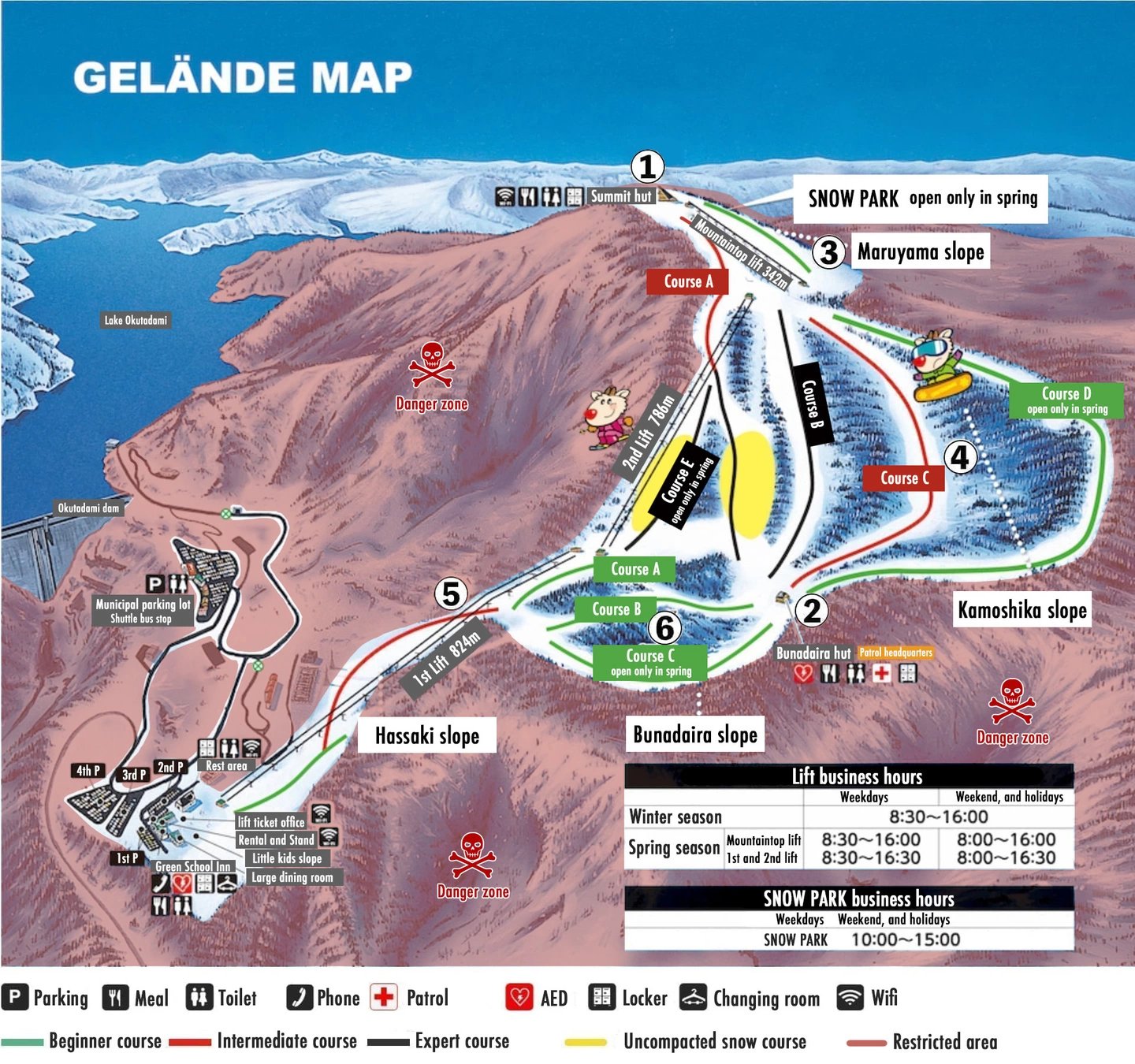
Trail Map
Accommodation
View MapOkutadami is not a ski-town resort. Most people treat it as a drive-in day or base themselves in the wider Uonuma area with an onsen plan. If you want the closest, most “in the mountains” vibe, look at Ginzan-daira Onsen near the lake area. Places like Kozanso (湖山荘) lean into the remote hot-spring lodge feel, with quiet nights and a proper end-of-day soak that hits different after spring slush turns.
For a classic Niigata onsen base with more practical access, Oyu Onsen and the Yunotani Onsen area are your friends. Gensen Yunoyado Kairi (源泉湯の宿 かいり) is the kind of ryokan stay that turns a ski mission into a trip, with that calm, cooked-dinner, soak-then-sleep rhythm. If you want something simpler and functional, Hotel Yunotaniso is another solid onsen-style option in the same general zone.
If you’d rather prioritise dining choice and convenience, base yourself nearer transport hubs like Koide or Urasa, where you’ll find business-hotel practicality and quicker logistics for multi-resort trips. For a higher-end stay that feels like a destination in itself, ryugon in the Minamiuonuma area is a strong splurge base, especially if you’re pairing Okutadami with other Niigata resorts and want one “treat yourself” night in the mix.
Powder & Terrain
Okutadami’s snow story is different to the usual Japow brochure. It can absolutely stack up, but the feel is often a touch denser and more “drive the ski” than Hokkaido fluff. When it’s cold, the surface stays friendly and you can still get those satisfying face-level turns. When it warms up, it becomes a spring-snow dream if you time it right, with soft, edgeable snow that rewards confident skiers who like to move fast.
The terrain is dominated by open faces and wide pistes, which is exactly why it works so well as a late-season destination. You’re not here for technical choke points or a labyrinth of gates. You’re here for long fall-line cruising, big GS turns, and easy visibility. Advanced riders will find pockets of steeper pitch and a few sections that keep you honest, but the mountain overall leans “flow” rather than “no-fall zone.”
Where it gets fun for pow chasers is the in-bounds tree texture. There are beechy tree lines and pockets between runs that ski like natural glades when coverage is good. They’re not endless, and they’re not a formal gate system, but they’re the places that stay soft longer after a storm or after a cold night reset. If you want your day to last, you’ll be rotating between the obvious groomers early, then dipping into trees and edge-of-trail features as the sun starts doing its thing.
Storm-day planning is straightforward. The best approach is to get your timing right rather than trying to outsmart the mountain. If it’s dumping and visibility is rough, stay lower, stay near the tree-lined parts, and keep your route simple so you can repeat it. If it’s a bluebird spring day, start early for firmer corduroy, then chase softening snow as the sun works across the hill. Okutadami can be ridiculously good when you catch that sweet spot before it turns to slush.
Crowd dynamics are usually kind to you, with one big caveat: when the park is a draw and the weekend is prime, lift lines can form because the chairs are old-school and not fast. The silver lining is that the terrain is open and disperses people better than tight tree resorts. As long as you’re not expecting high-speed gondy efficiency, it’s a smooth, low-stress mountain.
Getting There
Closest major air gateway is Tokyo (Haneda or Narita), then you’re looking at a Shinkansen-plus-car style trip. The most practical rail target is Urasa Station on the Joetsu Shinkansen, then drive the rest. By car, a common route is via the Kan-Etsu Expressway, exiting at Uonuma IC, then continuing into the mountains.
The main gotcha is the access road reality. Okutadami’s location is part of the reason it’s special, and part of the reason it’s not a casual add-on. Expect long tunnel driving and mountain-road conditions, especially around storms or shoulder-season freeze-thaw. Winter tyres are non-negotiable, chains are smart insurance, and you should be ready for road controls or temporary closures when the weather is doing weather.
As a rough planning baseline: Uonuma IC to the resort is about ~50 minutes by car, and Koide Station to the resort is about ~90 minutes by car. If you’re not driving, transport can be limited and schedule-dependent, so treat a car as the default play.
Who's it for?
- First-timersLimited
- Powder huntersGood
- Non-skiersLimited
- BudgetGood
- LogisticsLimited
If you like big, confident turns, spring missions, and a mountain that feels uncrowded compared to the big-name destinations, you’ll love Okutadami. It’s also a great call for riders who want to mix cruising with park, or anyone who wants “one more Japan ski day” after other areas start winding down.
If you need steep, technical terrain, or you judge a resort by how many gates and sidecountry options it has, you might feel limited. Same if you’re chasing that mid-winter, cold-smoke-only fantasy: Okutadami can deliver deep days, but the magic is often in timing, texture, and late-season longevity rather than pure mid-January chaos.
Food & Après
On-mountain food is what you’d expect: cafeteria-style, filling, and designed to get you back out the door. Think curry rice, noodles, and the kind of quick meals that make sense when you’re doing long spring days. Don’t come expecting a gourmet slope scene, but do come expecting you’ll be warm, fed, and moving again fast.
Off the hill, the best move is to make onsen-town dining part of the plan. Uonuma is rice country, and the local staples are simple and satisfying. You’ll also see plenty of Niigata sake on menus, and if you know, you know. Après here is not champagne and DJs. It’s a soak, a quiet beer, and an early night so you can get back on snow while it’s still firm and fast.
Japow Travel Tips
- Lift hours: typically ~9:00 to 16:00 (season and conditions can shift this).
- Season rhythm: Okutadami is famous for late-season skiing, and access conditions can shape when it’s realistically “on.”
- Avalanche / backcountry reality: this isn’t a gate-network resort. In-bounds tree skiing exists, but true out-of-bounds is not the vibe and enforcement can be strict.
- Weather & snow patterns: big totals, but spring timing matters. Mornings can be firm, afternoons can turn soft fast on sunny days.
- Language/cultural quirks: English support is limited. Signage is manageable, and the flow is simple if you’ve skied Japan before.
- Anything unique: the remote, tunnel-road access and the reputation as a spring-ski mecca, plus a strong late-season park focus.
- Nearby resorts worth pairing: Muika Snow Resort, Hakkaisan, Kagura, and broader Yuzawa-area options if you’re building a Niigata road trip.
Verdict: Spring mission, properly worth it
Okutadami Maruyama isn’t trying to be the biggest, steepest, or most international resort in Japan, and that’s exactly why it works. It’s a high-snowfall, low-drama mountain that comes alive when the season is fading elsewhere, delivering long runs, fun in-bounds texture, and that rare late-season stoke where you’re still getting real ski days in Japan while everyone else is packing the boards away.