

Luggage Forwarding in Japan for Ski Trips
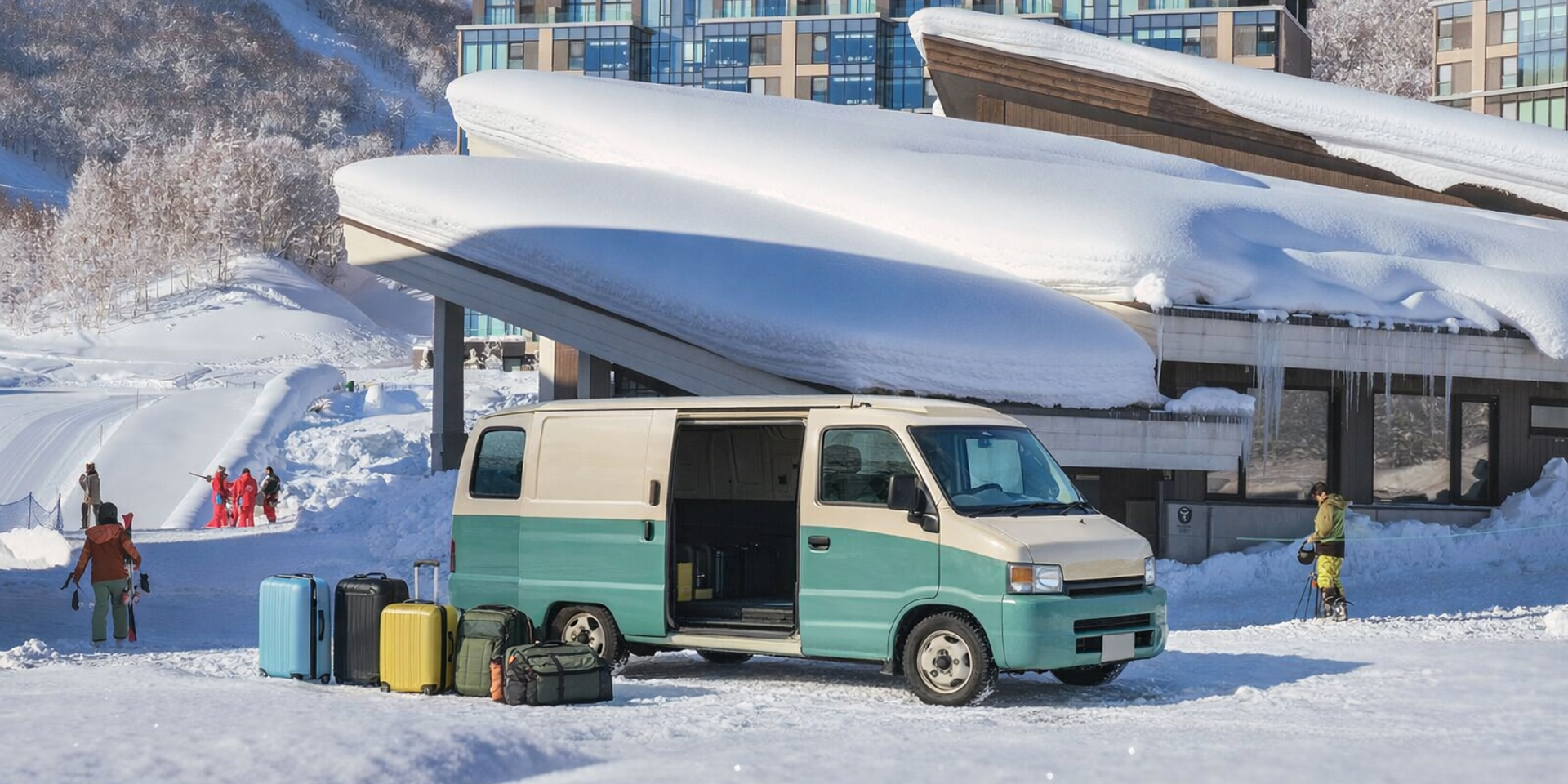
Cost, Timing & Ski Bags
Luggage forwarding in Japan (takkyubin) is exactly what it sounds like: you hand your bag to a delivery service, and it shows up at your next hotel or resort. It's popular in Japan because it’s fast, dependable, and reasonably priced, which matters when most travel involves trains, buses, stairs, and crowds. For ski trips, that reliability is exactly why people trust it with big ski and snowboard bags.
How much it costs
Takkyubin pricing is based on bag size (length + width + height) and distance. For ski travellers, the most common planning sizes are:
- Large suitcase: often Size 140 or Size 160
- Snowboard bag: often treated as Size 180 on ski-specific services, and a protective cover may be required
Here are solid planning numbers for the two routes people ask about most. These are one-way, per item.
Tokyo area → Nagano (one-way)
Large suitcase (Size 140): ¥2,190
Large suitcase (Size 160): ¥2,510
Snowboard bag (Size 180): ¥3,060
Snowboard cover (if required): ¥600
Tokyo area → Niseko area (Hokkaido) (one-way)
Large suitcase (Size 140): ¥2,710
Large suitcase (Size 160): ¥3,030
Snowboard bag (Size 180): ¥4,350
Snowboard cover (if required): ¥600
If you’re sending multiple items, just price them separately (e.g., suitcase + snowboard bag).
The fast way to estimate your exact price
If you want to be precise (especially if you’re unsure about size), use Yamato’s official rate table and estimator
How long it takes
Delivery time comes down to distance and cutoff times (when the bag is collected from the drop-off location). The cutoff is the part that trips people up: hotels, airport counters, and carrier offices don’t all run on the same pickup schedule. Hand it over after cutoff and you effectively add a day.
For planning a ski trip, the simplest rule is:
- Tokyo → Nagano and most Honshu ski areas: plan on 1 day lead time
- Tokyo → Niseko / Hokkaido: plan on 2 days lead time
- Peak season, remote addresses, or heavy weather: add a buffer day
If you want a confident yes/no for your exact lodge or resort, don’t guess. Use the carrier’s delivery-date checker with postcodes and it will show the earliest arrival date and the latest send-by cutoff for that destination.
Which service to use
Yamato TA-Q-BIN (Kuroneko)
This is the default option for most travellers because it’s everywhere, and hotel front desks know the process.
Official info: English site
Yamato Ski TA-Q-BIN (skis and snowboards)
If you’re sending a snowboard or ski bag to a resort, this is the ski-specific option. This is also where you’ll see the ski-bag rules, including covers.
Official page: English site
JAL ABC (airport baggage delivery)
If you want to ship directly from Narita or Haneda to your hotel, airport delivery can be a good start-of-trip move. Just treat it as something that needs normal delivery lead time rather than a guaranteed overnight courier to a ski town.
From the airport: English site
To the airport: English site
Where you can drop your bags off
There are a few reliable drop-off options. For ski trips, the best ones are the ones that handle oversized gear smoothly.
Hotel front desk (easiest): hand it over, fill the form, done.
Yamato sales office / service center: best if you want direct carrier handling or you’re staying somewhere unstaffed.
Airport counters (for airport delivery services): great if you’re landing and moving straight on.
Convenience stores: common for regular parcels, but not always ideal for oversized ski bags. For boards/skis, assume hotel desk or carrier counter is the safer plan.
How it works
You’ll do the same basic process almost everywhere:
You give the sender your destination details (hotel name, address, phone number), pick a delivery date, and choose a time window if available. You pay, you get a tracking number, and the bag arrives at reception.
A small but important detail: if you’re shipping to a resort or hotel, address it to the property front desk (not to your personal arrival time). Resorts are used to accepting luggage, and it avoids missed deliveries while you’re on the mountain.
Common timing mistakes
The single biggest mistake is assuming that handing your bag over in the late afternoon counts as that day’s shipment. Often it doesn’t.
If you’re planning around a specific arrival day, do two things:
- Ask the drop-off point what today’s pickup cutoff is.
- Use the delivery-date checker for your destination if the timing is tight.
That’s it. Once you respect cutoffs, takkyubin becomes predictable.